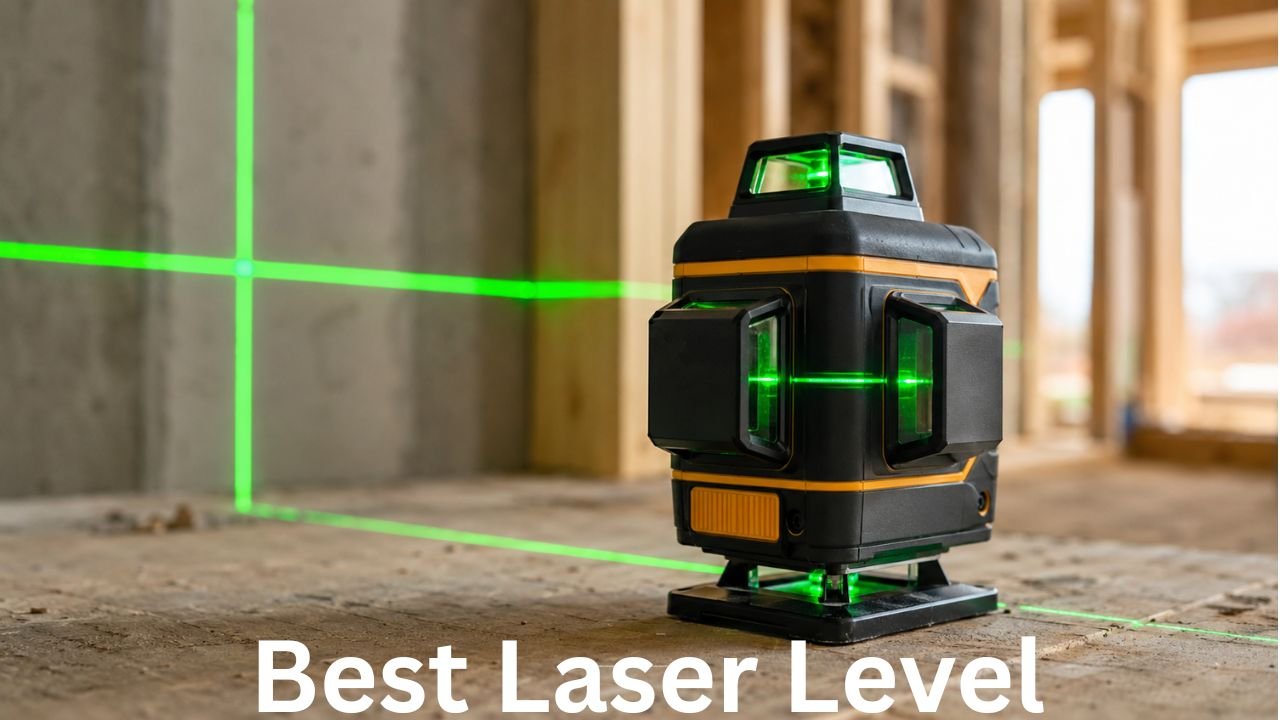
A good laser level can make home improvement projects faster, easier, and much more accurate. Whether you are hanging cabinets, installing shelves, laying tile, framing walls, or working on a larger construction project, having a reliable reference line can save time and prevent costly mistakes.
Unlike traditional bubble levels, laser levels project highly visible lines across walls, floors, or ceilings. This makes it possible to work with greater precision, especially when you need to align several objects over a large area.
But choosing the best laser level is not always straightforward. There are different types, beam colors, leveling systems, ranges, and features available. Some models are designed for simple household tasks, while others are built for demanding professional environments.
This guide explains what to look for in a laser level, the different types available, important features to consider, and how to choose one that matches your project.
What Is a Laser Level?
A laser level is a measuring and alignment tool that projects a straight laser beam onto a surface. The projected line provides a visual reference for determining whether something is level, plumb, or properly aligned.
Many modern laser levels use an internal self-leveling mechanism. When the tool is placed on a reasonably flat surface, it automatically adjusts the beam to create a level or vertical reference.
Depending on the model, a laser level may project:
- Horizontal lines
- Vertical lines
- Cross lines
- Multiple horizontal and vertical lines
- 360-degree lines
- Individual points
- Combination lines and points
These features make laser levels useful for everything from small DIY projects to professional construction work.
Why Use a Laser Level Instead of a Traditional Level?
A traditional spirit level is still useful, but laser levels offer several advantages when you need to work across larger areas.
With a standard level, you usually need to place the tool directly against the object you are checking. A laser level can project a reference line across an entire wall or room.
For example, if you are installing several picture frames, a laser line can help you keep all of them at exactly the same height.
Laser levels can also be helpful when:
- Installing kitchen cabinets
- Hanging shelves
- Aligning doors and windows
- Installing electrical fixtures
- Setting tile
- Mounting wall panels
- Building partitions
- Installing drop ceilings
- Completing flooring projects
- Checking vertical alignment
For many projects, the biggest benefit is convenience. Instead of repeatedly measuring the same distance, you can establish one accurate reference line and work from it.
Types of Laser Levels
Before choosing the best laser level for your needs, it is important to understand the main types available.
Line Laser Levels
Line lasers project one or more lines onto a surface. They are among the most useful options for general home improvement.
A basic model may project a horizontal line, while more advanced versions can produce horizontal and vertical lines simultaneously.
They are particularly useful for:
- Picture hanging
- Shelving
- Cabinet installation
- Wall decoration
- Tile work
Cross-Line Laser Levels
A cross-line laser produces both a horizontal and vertical line that intersect at a specific point.
This creates a cross-shaped reference that is extremely useful for alignment work. For example, when installing cabinets or wall fixtures, you can use the horizontal line for height and the vertical line for positioning.
For many homeowners and DIY enthusiasts, a cross-line model can provide a good balance between versatility and simplicity.
360-Degree Laser Levels
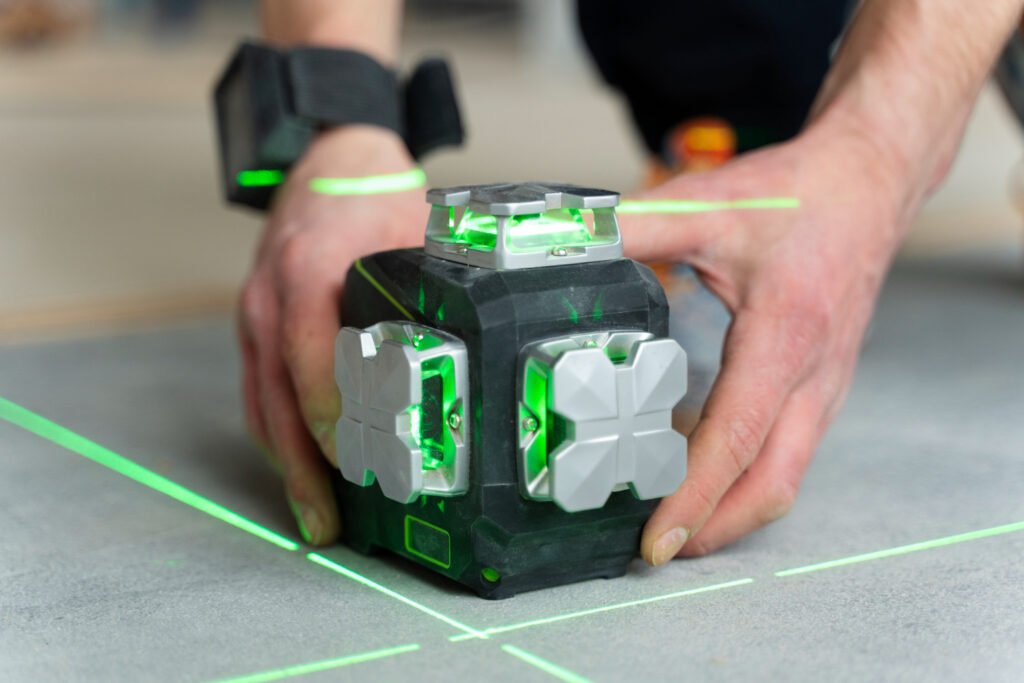
A 360-degree laser level projects a continuous line around an entire room.
Instead of manually moving the tool from one wall to another, the laser creates a reference around the space.
These models are especially useful for:
- Large rooms
- Ceiling installation
- Flooring projects
- Cabinet installation
- Wall framing
- Commercial work
A 360-degree model can be more expensive, but the convenience can be worthwhile for frequent projects.
Point Laser Levels
Point lasers project individual reference points rather than continuous lines.
They can be useful for transferring measurements from one surface to another, such as transferring a point from the floor to the ceiling.
Professional contractors may use point lasers for specific layout and alignment tasks.
Important Features to Look For in the Best Laser Level
Not every laser level offers the same performance. Before buying one, consider the features that actually matter for your projects.
| Feature | Why It Matters | Best For |
|---|---|---|
| Self-leveling | Automatically corrects minor positioning errors | DIY and professional work |
| Green beam | Usually easier to see in bright conditions | Indoor projects |
| Red beam | Efficient and often more affordable | General indoor use |
| 360° projection | Creates continuous reference lines | Large rooms |
| Multiple lines | Provides more alignment options | Construction and remodeling |
| Adjustable brightness | Helps visibility in different conditions | Indoor environments |
| Tripod compatibility | Makes positioning easier | Repeated measurements |
| Durable housing | Helps protect the tool from job-site conditions | Professional use |
| Long working range | Allows work across larger spaces | Construction projects |
| Rechargeable battery | Reduces dependence on disposable batteries | Frequent users |
Green Beam vs. Red Beam Laser Levels
One of the most common questions when choosing a laser level is whether to select a green or red beam.
Red laser beams have been used in laser levels for years. They are generally suitable for indoor work and are often available in more affordable tools.
Green beams are usually easier for the human eye to see, particularly in brighter environments. This can make them useful when working in rooms with strong lighting or larger spaces.
However, beam color should not be the only factor you consider.
A high-quality red laser level may be a better choice than a poorly designed green model. Accuracy, build quality, leveling performance, range, and intended use should all be considered together.

Self-Leveling Is an Important Feature
Self-leveling is one of the most useful features in a modern laser level.
A self-leveling tool uses an internal mechanism to compensate for small positioning errors. Instead of manually adjusting the tool until the line is perfectly level, the laser makes the correction automatically within its specified range.
This is particularly useful when working quickly.
However, self-leveling does not mean the tool can be placed anywhere. Most models have a limited compensation range. If the tool is positioned too far out of level, it will usually indicate that it cannot establish an accurate reference.
Always place the laser on a stable surface and follow the manufacturer’s instructions.
Accuracy Matters More Than Extra Features
When searching for the best laser level, it can be tempting to focus on the number of features included.
But accuracy should come first.
A laser level with many functions is not very useful if its projected line is inaccurate.
For professional work, check the manufacturer’s stated accuracy specification. For occasional household projects, extremely high precision may not be necessary, but reliable performance is still important.
It is also a good idea to periodically check your laser level’s accuracy, particularly if it has been dropped or exposed to rough handling.
Consider the Working Range
The working range tells you how far the laser can project a usable reference.
For small indoor jobs, you may not need a very long range. A compact laser level can be perfectly adequate for hanging shelves or pictures.
Larger construction and renovation projects may require a greater working distance.
Some laser levels can also be used with a detector to extend their effective range in bright conditions or outdoor environments.
Think about the spaces where you will actually use the tool rather than automatically choosing the model with the longest advertised range.
Durability for Construction and Job Sites
A laser level used around a home does not necessarily need the same level of protection as one used on a construction site.
If you work professionally, look for a model with a strong housing and appropriate protection against dust, debris, and accidental impacts.
A protective carrying case is also valuable. Proper storage can help protect the laser from damage when it is not being used.
For occasional DIY work, durability is still important, but you may not need a heavy-duty professional model.
Tripod Compatibility Makes Positioning Easier
A tripod can significantly improve the usefulness of a laser level.
Instead of placing the tool on random surfaces, you can mount it at a specific height and adjust its position easily.
Tripod compatibility is particularly helpful when:
- Installing cabinets
- Setting tile
- Working on ceilings
- Aligning multiple objects
- Measuring larger rooms
- Performing repeated layout work
If you expect to use your laser level regularly, choosing a model with a standard mounting option can be a smart decision.
Choosing a Laser Level for DIY Projects
Homeowners typically do not need the most advanced professional laser level.
For basic DIY work, look for a model that offers:
- Self-leveling
- A clear horizontal line
- A vertical line if needed
- Simple controls
- Reliable accuracy
- Good battery life
- A stable mounting option
A cross-line laser can be particularly useful because it provides both horizontal and vertical references without being unnecessarily complicated.
Choosing a Laser Level for Professional Work
Professional users generally need more than basic alignment.
Depending on the trade, useful features may include:
- Multiple laser planes
- 360-degree coverage
- Greater working range
- Laser detector compatibility
- Strong impact resistance
- Improved visibility
- Rechargeable batteries
- Fine positioning controls
- Multiple mounting options
Contractors who regularly work on large rooms or commercial projects may benefit from a more advanced multi-line or 360-degree laser.
Common Mistakes When Using a Laser Level
Even a high-quality laser level can produce poor results if it is used incorrectly.
One common mistake is placing the tool on an unstable surface. Movement can cause the projected line to shift and lead to inaccurate measurements.
Another mistake is ignoring the tool’s leveling warning. If the laser indicates that it cannot self-level, do not treat the projected line as an accurate reference.
Other mistakes include:
- Measuring from an incorrect reference point
- Using a dirty or damaged lens
- Ignoring battery warnings
- Working outside the tool’s recommended range
- Failing to secure the tool properly
- Assuming the laser is accurate without checking it
- Using an indoor model in unsuitable outdoor conditions
Taking a few extra seconds to set up the tool correctly can prevent much larger problems later.
How to Maintain a Laser Level
Proper maintenance can help your laser level remain accurate for years.
Keep the optical windows clean using appropriate materials recommended by the manufacturer. Avoid harsh chemicals or rough cloths that could scratch the surface.
Store the tool in its protective case when possible.
Also avoid unnecessary drops and extreme temperatures. A laser level is a precision instrument, and rough treatment can affect its internal components.
If the tool has been dropped, it is worth checking its accuracy before using it for an important project.
Is an Expensive Laser Level Always Better?
Not necessarily.
The best laser level is the one that provides the features, accuracy, visibility, and durability you actually need.
A homeowner who uses a laser twice a year may gain little from purchasing an expensive professional model.
On the other hand, a contractor who relies on the tool every day may save significant time with a durable model that offers multiple planes, longer range, and better positioning options.
Instead of focusing only on price, consider the tool’s overall value.
Ask yourself:
- How frequently will I use it?
- Will I work indoors or outdoors?
- Do I need horizontal and vertical lines?
- Will I need 360-degree coverage?
- How large are my typical work areas?
- Do I need a detector?
- Is durability important for my work environment?
These questions can make the buying decision much easier.
Safety Tips When Using a Laser Level
Laser levels are generally easy to use, but the laser beam should still be treated responsibly.
Never deliberately stare into the beam or point it toward someone’s eyes. Follow the laser classification and safety instructions supplied with the tool.
Keep the device away from children when it is not being used.
For professional environments, make sure everyone working nearby understands the basic safety precautions associated with laser equipment.
Best Laser Level: What Should You Look For?
There is no single laser level that is perfect for every user.
For basic home projects, simplicity and dependable self-leveling may be the most important factors.
For remodeling, a cross-line or multi-line model can provide more flexibility.
For professional construction, a durable 360-degree or multi-plane laser with a long working range may be more appropriate.
The key is to match the tool to the job rather than paying for features you will never use.
Frequently Asked Questions
What is the best laser level for home use?
For most homeowners, a self-leveling cross-line laser is a practical choice. It can handle common tasks such as hanging shelves, installing cabinets, aligning pictures, and completing basic remodeling projects.
Is a green laser level better than a red one?
Green beams are generally easier for the human eye to see in bright conditions. However, red laser levels can still provide excellent performance indoors. Accuracy and build quality are more important than beam color alone.
Are laser levels worth buying?
Yes, especially if you regularly perform DIY, remodeling, woodworking, tile, or construction projects. A laser level can make alignment faster and reduce the need for repeated manual measurements.
Can a laser level be used outdoors?
Some laser levels are designed for outdoor use, particularly when paired with a compatible laser detector. Standard indoor models may be difficult to see in direct sunlight, so always check the manufacturer’s specifications before outdoor use.
How accurate should a laser level be?
The appropriate accuracy depends on the project. Professional construction work may require tighter tolerances, while simple household tasks may not need the same level of precision. Always check the manufacturer’s stated accuracy before purchasing.
How do I know if my laser level is still accurate?
You can perform an accuracy check using a controlled reference setup, following the manufacturer’s recommended procedure. If the tool has been dropped or handled roughly, checking its accuracy before important work is especially important.
Final Thoughts
Finding the best laser level does not necessarily mean choosing the most expensive or feature-packed model. The right choice depends on how you plan to use it, the size of your projects, the working environment, and the level of precision you require.
For everyday DIY tasks, a reliable self-leveling cross-line laser can provide plenty of capability. More demanding remodeling and construction work may justify a multi-line or 360-degree model with a longer range and stronger construction.
Before making a purchase, focus on accuracy, visibility, self-leveling performance, durability, working range, and mounting options. Choosing the right combination of features will give you a tool that saves time, improves alignment, and makes your projects considerably easier.
Also Read: Tomato Companion Plants: The Best Plants to Grow Near Tomatoes


One thought on “Best Laser Level: How to Choose the Right One for Accurate DIY and Professional Projects”